

Marken brauchen Eier!
Brands Need Guts
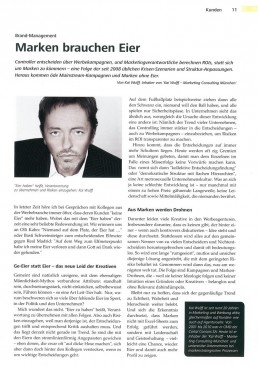
The new business magazine was kind enough a few years ago to publish one of my blog articles in their latest issue. Thank you new business! The article describes the development of the influence of controlling-driven resources in large companies. The result is soft-
Zombie Brands
One consequence is rather lifeless zombie brands that occasionally appear out of nowhere, give you a fright because marketers like me wonder how one could lead this brand into such insignificance. But then they become invisible again, imperceptible, gone.
This may also be related to the flood of new brands. Loads of startups with fresh ideas and new brands – often stylishly short like OUI, OQI, QUO, …. They shake up the markets considerably, so that not taking them seriously only works until the first survey. Admittedly: leading brands
Then they suddenly question entire industries. Like banks and insurance companies. Which means that status brands like Deutsche Bank quickly become obsolete (business) models. And these brands in particular should now heed the call 'Brands Need Guts'. They are now
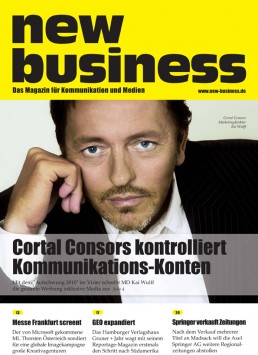
new business cover from my time at Consors


Tech-Nick - the perfect testimonial from SATURN
Antoine Monot Jr. thanks Saturn for „Tech-Nick“
Antoine Monot Jr, known as „Tech-Nick“ from Saturn, is „grateful“ for his advertising role. „The popularity gives me many freedoms“, said the German-Swiss actor („Absolute Giganten“, „Ein Fall für zwei“) to the ̶
He doesn't care whether popularity comes from a „Tatort“ role, advertising or hosting a show. „I believe we actors can consider ourselves lucky if we have one thing for which people notice us.“ Today in Germany, you only become popular through
Since 2013, the 40-year-old actor has been advertising for the electronics retail chain Saturn. Campaign motto (agencies: Redblue Marketing, Serviceplan Hamburg): „Tech questions? Ask Tech-Nick“. Initially, Monot Jr. advertised silently, but now he can also chat online. And flirt.
Pretty
Perfect
The role suits Monot, as the 40-year-old is himself an enthusiastic tech fan, as he reveals to the „Süddeutsche“. And: „We're lucky that we always get to tell funny stories with the Tech-Nick character. That, in my opinion, is what makes this figure so successful
The real success for Saturn, however, is the brand constant that the company can maintain through Tech-Nick. For years, the spots have been successful and the moving images can be excellently scaled across digital media. After years of experimentation, a breakthrough for Saturn.
Exactly what Mediamarkt is still missing.
Sources: W&V, Süddeutsche, Saturn Hansa

Die Götter müssen verrückt sein: Spots von ALDI
Does brand management stop at the POS?
What ALDI has perfectly staged in Europe for years is the brand in retail. POS, ads, inserts, etc. are coherent, complement each other, interlock. This has made the company strong and the brand resilient. But now the step into – for ALDI – new media: TV and cinema. Two
Here is the new cinema spot.
ALDI's step into TV is a novelty in Germany
The campaign launches this coming weekend: On
Gedreht haben den entsprechenden Werbeclip die Newcomer-Regisseure Daniel Titz und Dorian Lebherz, die schon mit dem bei YouTube millionenfach geklickten Spot „Dear Brother“ für den Whiskeyhersteller Johnnie Walker einen Überraschungshit gelandet haben. Die TV-Präsenz ist aber nur ein Teil der Kampagne „Einfach ist mehr“. Darüber hinaus wird es auch Radio-Spots geben, großflächige Plakate und Zeitungsanzeigen sowie eine Kinowerbung, in der Göttervater Zeus in 84 Sekunden erkennt, dass der wahre Luxus nicht auf dem Olymp liegt, sondern im Einkauf bei Aldi. „Dahinter steckt jeweils ein Augenzwinkern“, betont Jeannette Thull, die Geschäftsführerin im Zentraleinkauf von Aldi Süd.
ALDI wants to specifically strengthen customer loyalty
Products are neither visible in the TV spot nor in the cinema ad. And that's intentional. According to ALDI, it's not about praising prices or quality of their range or even the
Stupid
TV Spot
Where is ALDI in the ALDI spot?
So in the 47-second TV spot, not a single ALDI product and not a single ALDI store is actually visible. Instead, children playing in puddles, romping through the apartment are shown
…and the current TV spot
What's particularly alienating is the know-it-all chatter of the children, which clearly comes from the pen of copywriters and was dragged through dozens of correction loops.
Here's the full textual fireworks of the 47-seconder:
„Adults always want to be the bosses because they think they're pretty smart. But when you ask: Why do we have to hurry? Why don't you have time to play? Then they answer
And the brand?
What overall strikes me as very strange is the impression that in ALDI's brand management – perhaps also due to the North-South combination – no clear line is discernible. Quite the contrary.
Kai Wulff
(additional sources: stern.de, welt.de)

Ikeas beste Kampagne
Beautiful IKEA campaign from England
IKEA has always shown a beautiful instinct for how to emotionally engage their target audience. Particularly beautiful is the campaign from England for the beds theme. The spot itself is the
"The wonderful everyday" – that's the claim of the British IKEA campaign. Trade magazine "Campaign" crowned it campaign of the year 2014, because the spots created by Mother agency are also wonderful
Life-
Feeling
The spot promotes the furniture manufacturer's wardrobes as the perfect storage for favorite clothing, bringing order to everyday life. Mother brings T-shirts to life, letting them move like a

Brand Performance today
Brand Performance
Brand study on Brand Performance with a future focus instead of status analysis. This is the approach that GREY Germany and TNS Infratest have taken with the support of the German Marketing Association and the Brand
At the top of the drivers named by over 160 brand managers and marketing decision-makers that determine future viability are well-known and seemingly established values like 'Trust', 'Customer orientation'
"Trust"
* At the level of "Brand Contest", a brand gains competitive strength by looking from inside out. It takes care of established drivers like performance, relevance or differentiation and is
* To motivate the target group to engage with the brand, Brands Ahead must find their own standpoint at the "Brand Content" level. Which Brand Content – which communicated content
* Relevant content is increasingly determined by the target group's environment. At the "Brand Context" level, the brand gains importance when it seamlessly integrates into the everyday life of customers
Six Core Drivers
"Everything stays different: this best describes the future challenge. Brand missions, attitudes, performance promises naturally remain important, but increasingly flexible and agile. Brands
The six core drivers for Brand Performance
Another key finding of the study is that there are no blanket answers for the future viability of brands. These would not reflect the individual brand reality with the number of possible
Brand in transition. Established drivers remain, but must be reinterpreted.
As "always important", known aspects such as trust, customer orientation, performance promise and attitude/mission are classified. An exciting indicator of brand in transition is the age split. While
Concentration vs. Complexity.
Challenge: The balancing act between the clearly defined brand core and the multiple instruments of brand management.
Prototypical for the balancing act between complexity and concentration is the high approval for the fact that brands don't have to be managed democratically, as well as for the fact that brands can be participatory
Relevance is created through context. Personal meaning is created through flexible action in the living environment.
Relevance, in contrast to static brand positioning, takes on a significantly more dynamic facet. It must reflect the change in situational moods. The ability to react rather than act
Dialogue depth beats dialogue breadth. Dialogue quality is more important than the variety of dialogue platforms.
Especially against the background of the digitalization of communication, an almost homogeneous picture emerges: the mere possibility of dialogue does not yet allow differentiation. But investment in good dialogue
More empathy instead of just technology. The benchmark for innovation culture is the person with their needs.
Innovation capability is rated higher for one's own brand than for brands overall – an interesting self-image/external-image contrast. Decisive is the high approval for innovation to
Attitude vs. Function.
Value promise supplements performance promise. Brands must be equipped for competition on both levels.
Knowing that values don't automatically make a brand future-proof, a clear and lived value attitude of a brand is affirmed by nearly all respondents, as is that behind every trend
"Brands have the power to reflect values and form value communities. Without the corresponding performance support through the brand, neither the formation of pure value communities nor the
Prof. Dr. Ralf E. Strauß, President of the German Marketing Association, also sees the clear leadership mandate on the side of brand makers: "However, for the marketing organization itself to be future-proof